Saturday, February 2, 2013

Curious Behavior Of Starlings

Starlings, though an introduced bird in New Zealand, are very common and especially so in the rural landscape.
We have two types of grass grub and they tend to be the main diet of Starlings, although they certainly eat earthworms, insects and some fruits.
Farmers encourage Starlings on their properties by providing nest boxes but the nest in buildings and the mess they make is considerable - not to mention the smell!

One pair regularly nested under the cowling of my tractor - on top of the radiator - well the same pair? No because one was chopped in half one time with the fan blade! But when there were chicks, the parents would follow the tractor around and when chance permitted, they would feed their young - each year the chicks fledged.

As I watched on the lawn in front of our house, I saw Starlings doing this sort of thing. Now you may think this was just normal preening - but no. Individually each would go to the same spot pick something from the grass and 'put' it under it's wing! Like applying deodorant! They 'preened' in no other part of their body and always they picked something up.

So I went out to take a look and there was an ant nest. Just the little black ants in a not very strong nest that are not necessarily common.

I can imagine the birds eating the ants, and I can imagine the ants climbing on to their attacker and biting, but only under the wing? Maybe, maybe not.

Just a curious thing

Monday, January 21, 2013

W.P. McKerrow


Bill McKerrow died recently and will be sorely missed as community minded and busy member of the district.
He is remembered here because his farm bounded Fraser's (South) Block of the forest.

I remember Bill first at the Waianakarua Garage (rolling a smoke) where, like many of the local farmers he came on rainy days to have repairs made that they were too busy to have done on fine days. And there was always the opportunity for a chat.

For the first two or three years after NZFS purchased the property, access was a problem and we would have struggled without the cooperation of Bill and Dr. Douglas. It was real cooperation because the track through Bills paddock cause a loss for feed for him (we used existing tracks through the Doctor's property).

Of course the change of land ownership to NZFS caused changes/constraints.
There was a spring that had been tapped to supply water to the McKerrow household as well as to several properties down across the main road in the Waianakarua settlement. Bill took on the voluntary role of caretaker of the water supply and found the blockages and breakages - sometime I helped him.
Of course as the trees grew, the spring was destined to dry up so for the long term they, not us, had to find an alternative supply. 
We were very careful in land preparation not to apply gorse control chemicals anywhere near that spring.

The boundary was a sea of gorse and Bill told me that he realised there would be constraints on him to burn his side once we had established trees there and he asked me what he should do.
I suggested that he plant trees the same as we were doing making it a common boundary (although we did establish a fence there.
He did so and as far as I know made a healthy profit.

In fact, Bill is remembered in Tanzania as I used this story (embellishing it of course to suit) as inspiration to primary schools. The story went like this:
Bill McKerrow my friend and neighbor of the forest I worked as no longer allowed to burn his rough vegetation next to our trees. I suggested that he too should plant trees and maybe one day he would be rich! The trees grew well and he cared for them and stopped predators from eating them.
Twenty five year later, Bwana McKerrow harvested his trees and made a good profit.
One day he came to tell me how pleased he was, and as a gift he brought me a big red bull! His horns were as wide as my truck and the animal was big [I stepped out four paces], and tall [I gestured with my hand, about shoulder height}. So you see my students, there is profit in planting trees!

Bill was born and bred in the district, schooled as well and became a Justice of the Peace, a District Councillor and was honored by the Queen.

There is lots more to add - he was a piper, a long time tennis player - in one family three generation have played against/with him - there is a list.

Ranking his achievements is not the object of the blog, his historical importance to the forest and myself is.
One thing though, the Herbert/Waianakarua water scheme was in trouble with it's water right/allocation meaning the could be no additions. Bill gave up his irrigation water right which meant that the district could prow and prosper.


I have no doubt that Bill still shares his humor.


Ken Matches

This blog is fast becoming an obituary column!

Ken Matches (89) recently died and while he had nothing to do with forestry, he is the last of his line and has historic relationship with Breakneck Road and out little valley with the gates that named their property as 'Goblin Woods'.

I rented 'sleepout' huts on the terrace below the Matches house and I have already written a little about old Bill Matches, Ken's father. But I mainly knew Mrs. Matches (nobody used her christian name) who by then was a bent old lady with er grey hair tied in a bun. Mrs. Matches was one of those good matriarchs - wise and warm.
We helped each other from time to time and also looked out for each other.

Richard was the younger son who suffered from polio leaving him with a stiffened neck. Richard was married in Australia but Mrs. Matches was unable/unwell to travel there. So a tape recording of the event was made and posted to her. She asked me to sit with her to listen and she had prepared a small party for us. She shed some tears privately in the next room, but came out refreshed to enjoy the food she had prepared.
Richard died perhaps four years ago.

Neither Richard or Ken had children so indeed it is the end of the line.

The Goblin Woods property was much larger than these days. There was the house area and then the area where 'my' huts were; then the large raspberry patch - where Ken built his holiday house - then an area of garden, where I grew spuds; then the area of Radiata Pine that extended to what is now Clark's crib.
These trees were damaged in the 1975 gales and after the cleanup, I erected the post and wire fence.
The area was divided up eventually - first for Essemburg's house, then Polson's crib, and finally for Collett's house.

Ken's holiday house was built by Dave Armour and we assisted to lift the framing into place - made from Thuja plicata (western red cedar) and quite heavy - probably still a bit green.
Ken and his second wife used to stay on occasion and we spoke from time to time.
Ken lived and worked in Christchurch and I did not really know much about him

The death of the last Matches of Breakneck road sees the end of an era.


Saturday, January 12, 2013

Tap - Graham Fradelle Tapper

It is with sorrow that I report on 3 January 2013 we lost our good mate Tap to an aortic aneurism.
 He would be pleased that I posted this picture of him.

Twenty nine young men assembled (together with some others who were to head off to university) as Forest Ranger Trainees in February 1962, almost 51 years ago. This was for an induction course of some six weeks, where many of us bonded to some extent, and then we were divided into groups of 'our own conservancies'.

Conservancies were roughly geographical areas based on provinces as a managerial tool for the New Zealand Forest Service.

My home conservancy was Canterbury and there were five Canterbury boys: Graham Tapper, Les Seaward; Tony Russell, Colin Goodrich and Gordon Baker.
This meant that the six of us worked together for our year of practical training. We spent time at the forests of Kakahu, Raincliff, Ashley, Hanmer and Omihi as well as some logging at a private farm at Waimate. Only at Ashley and Hanmer were there cookhouses/forest camps, the other places we were batching in old and rundown farm houses and did our own cooking.
There are many stories of those days, but maybe not for here, but as I had a vehicle, we all travelled together.Graham, to show his appreciation insisted that I was to be his first passenger when he gained his [proposed] glider pilot ticket. Of course it never happened because of his accident, but I could imagine that flying with Tap would be at the least - exhilarating!

Following that first year, we studied (mainly) indigenous forestry (protection, production and management) at the Reefton Ranger School including the wild animal (then called noxious animal) control at Dip Flat.

 Tap is the forth face from the left of the standing guys.

 Our third year was spent at the Forestry Training Center at Rotorua where we studied all aspects of exotic forestry  from roading through establishment to harvesting.

For some of us the friendships forged in the first year stuck, and other friendships were forged in the following two years through closes association and like-minded philosophies.
We have biennial get-togethers  at various places and very good contact with all of us is through the efforts of Ross Lockyer.

After the Rotorua year, we went our separate ways into branches of forestry that took our fancy at the time. The completion of the fourth year would give us out Forest Ranger ticket - qualification.

Myself, I opted for general forestry and was posted to Naesby Forest. Tap opted for logging and was posted to Kaiangaroa Forest. 
During that first year Tap was injured in a freak logging accident that left him without the use of his legs and he remained in a wheelchair for some 47 years. We were told that he was the oldest living paraplegic in New Zealand.

Tap was always a practical, good humored guy with a can-do attitude which helped him in his rehabilitation and establishing himself in a new and unexpected life. He retained his love for the outdoors.
Importantly he married Annabel and was a very proud father of two and a granddad to four.

His work at the Burwood Hospital Spinal Unit is where his inspirational character really came out! Not only did he mentor people who were patients at the unit but he inspired them by example that being wheelchair bound was a new direction, challenge and full life.
If Tap wanted to do something he would find a way - maybe a long way, but a way.
For his work in the Spinal Unit he received a New Zealand Order of Merit but even so we forestry lads believe him to be a hero, an unsung hero!

Tap stayed with us when he came with Barry and me to attend Jack Palmer's funeral [that's Jack standing on Tap's right in the photo]. His disability only manifested itself because we have steps at our house and not a ramp, therefore I had to help him up - otherwise he was so organized, her was just a mate visiting.
Unfortunately he followed me to Dunedin in his car as we intended to go in different direction, and as he lost sight of me for a few moments, he sped up to catch me. The cop followed him into the supermarket carpark and despite my attempt a diplomacy, he recieved a $100 speeding ticket!
Tap and Annabel set up a caravan and they parked in our yard on their first [and as it turned out, last] expedition. I was able to make a few minor adjustments for his ramp, but they had it very well set up very well.
Appropriately, Tap's funeral was large and there was much to say, but Colin Goodrich's final words were, 'It may be an oft used cliche, but Tap did indeed leave the world better than how he found it.'
Some pictures.
  The young Graham Tapper.


Tap in the center, with John Reid and Rob Woodney rest at the corner waiting for transport.

Our training made us fit and taught us good techniques of bushcraft and living healthily in what these days may be termed as primitive conditions.


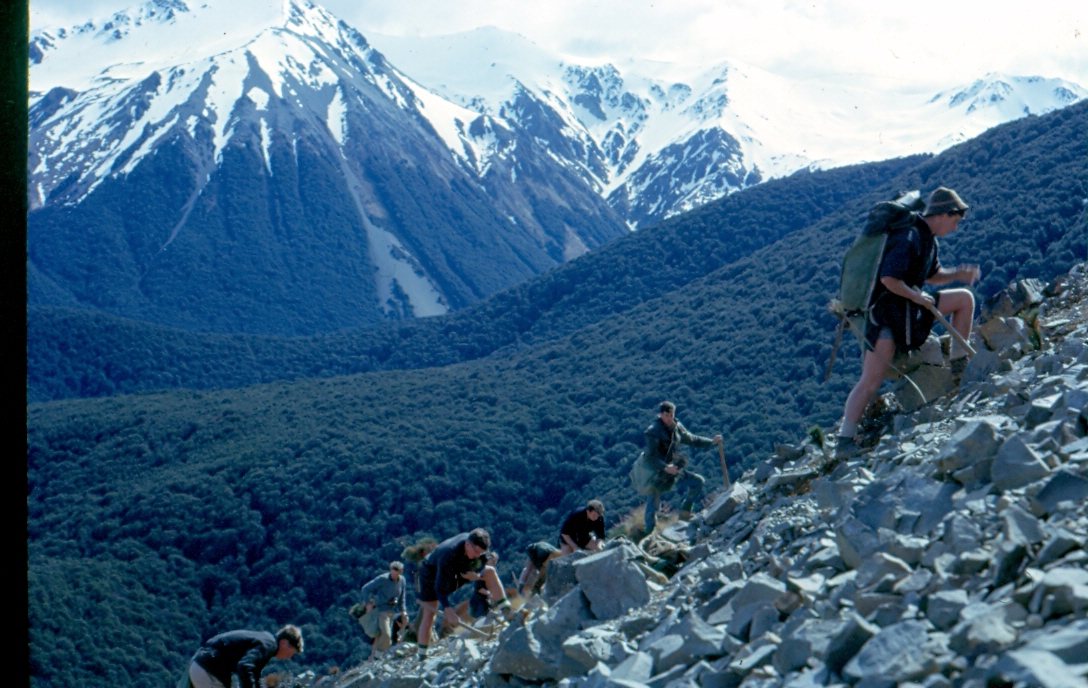
 Hard, physical work. Planting trees on a shingle scree at Craigeburn. This was done to prevent erosion [and probably introduced species that that are hard to get rid of today].


Tap sitting there in the green shirt, not looking at the camera.

Grouped again waiting for transport.


Fly Tap!

Sunday, June 10, 2012

Trush Song


When I was but a lad, I used to tell my Mum that I could hear a Thrush, high in the walnut tree singing,'Good morning to you, good morning to you!' As if it was personal.

On my early morning stroll, I hear the same call. There is a Thrush sitting on the high point of a Macrocarpa tree [the same tree each morning] and he/she spends the best part of an hour saying 'good morning' as the sun rises.
I have no idea why they do this but it is their habit, no doubt corresponding with like minded fowl. It is in competition with Blackbirds, Bellbirds and Tuis. As well as a huge flock of Starlings congregating in a stand of Eucalyptus at this time of the year.

We have been critical of the early settlers because they brought with them mistakes like rabbits and hares, gorse and old man's beard, to name a few.
Presumably they brought Thrushes and Blackbirds for their song and I don't blame them for that.
Thrushes and Blackbirds pay for their robbery of strawberries, raspberries and currants with their song.

Not so Starlings, whose warble I enjoy but generally  have no beauty in their song - they do a job though in consuming grass grub but we pay for that with the mess they create.

House Sparrows too  turned out to be a dud, but Hedge Sparrows are pleasant enough - both to look at and their plaintive song.

Nostalgic Englishmen introduced the Skylark and the reward us country folk with their pleasant trill flying high, then dropping like a stone and cunningly walking some 20 metres to their nest. They do little or no damage to the environment.

But I like the Thrush

Tree Deliveries

There is  logistical process in delivering trees to the planting site which started in the morning loading the vehicle with trees - usually before the work force arrived. This turned out to my task and to take them out on to the planting site.
The efficiency of the planting job depended to some extent in have trees available to the planters without them having to walk far to fill their planting bags. So on occasion, I would do that by carrying them on my back - but more often, using a vehicle of some sort.

Here we have an A2 Bedford and an old K Bedford, The K Bedford was a gang transport and the A2 was used [among other things] for tree deliveries and for going to the Milton nursery to collect trees. One load was really a day's work because in the early days we were using puddled bundles. So they had to be unloaded 'on the hill', rather than in a shed as we would later with cartoned trees.


We inherited an old Commer, a cast-off from Naesby Forest - of course she was yellow and had an aluminum canopy. She also had a crash gearbox so you had to double the clutch each time you changed gear - not everyone could manage her. Generally she was slow but the low gear was a crawler gear really and as long as I had reasonable traction, she could climb steep slopes. Many a time though Mick had to retrieve me with the Cat D6. He would also tow me using the truck as a trailer to get trees into the site. Sometimes the situations were tricky though.

A frost plug at the back of the motor rusted badly and was deemed irreparable, so the old Commer was taken from me - well I delivered her to Conical Hill 'for disposal'.
So to replace her I was provided with a Yamaha motorbike and some wet weather gear [a fairly unfriendly act I would say]. It was not really a lot of use for what we required, so a 72 tooth rear sprocket was installed - great on the hill, but screamed on the open road! Robert Hutton built a frame to hook a trailer to and he built a trailer so I could tow a load. Well it was ok, but heavy loads of trees took control sometimes and we would tip over on occasion. Our Mechanical overseer guy, Bob Williams did not appreciate the towing frame being added, nor did he like the trailer as such a thing was a 'unit'. He undid the thing and took it away with the trailer. Luckily after the planting season. The bike and I parted company at the back of Trig J and she rolled down the steep hill until some Manuka bushes held her up. The repair bill had to go to District Office, which is why [after the please explain] I was awarded the Suzuki LJ 50.

Jimmy was a three cylinder two stroke little power-horse and valuable on the forest. For tree deliveries, I would take the trees from their carton, [they were in plastic bags of 100] and carefully stack them in the back and on the passenger seat. Out on the hill I would have to cover them and be mindful of tree care, but the system worked well. One time though, I had trees laid out and there was heavy snow, so I went out on my own to recover the trees. The landscape and tracks changed with the snow and really it was dangerous - compounded by being on my own out there. Happily all was well and the task was completed - if with the odd tricky moment.

As the programme became bigger we received a big, red Nissan Patrol, short wheelbase with a 4 litre petrol engine. This was luxury plus for me and, I always thought a bit over the top.
The vehicle was brilliant for pulling the fire trailer as it had all this power.
At Trotters Gorge [Kemp's] the roading crew were a bit slow and planting was well ahead of them. I ferried the planting gang into the planting area - in the morning the track was hard with frost and in the
 afternoon, greasy with the thaw! But I had created 'rail tracks' during the afternoon trips that were so deep, I just had to follow them.
We had a huge tandem trailer and I would daily go into Oamaru where there would be a wagon load of trees. I could fit the whole load on the trailer and haul it up to the planting site.
Trailers upset your stability and I recall one instance where I was trying to climb a steep, narrow ridge to deliver trees, but despite the forward gear, we were sledging backwards - I'm not quite sure how I kept the trailer straight.
Rather than abandon the idea, I put tyre chains on the front wheels but still could not get up that ridge. So I strapped a big bundle of heavy Manuka planting poles to the bull-bar and that gave me enough traction to deliver the trees.
Those very trees have now been harvested.


Friday, June 8, 2012

The Planting Season


As I headed out for my usual walk this dark, frosty morning, I saw the Blakely Pacific planting crew heading out to start the seasons planting. I like planting and the concept of creating a forest or perhaps replanting one so this started me thinking again.

First, we never called them a 'planting crew', they were a planting gang! Nothing to do with those hoods who create mayhem and are mostly outside the law!
Secondly it is still early in June. 1st of June is the start of winter though some may argue that winter actually start on the shortest day, 21st of June. I doesn't matter a lot.
I like to start plant as late as possible much to the chagrin of the nursery. Of course this depends on the size of the programme and if you have a fixed sized gang, then you must know their daily production and work out when best to start.

The reason for this is simple. Why plant out trees that will have to withstand the forces of nature's winter, any earlier than is necessary? Unless the winter is very mild, the seedlings will put on nil growth so there is no advantage - other than time constraints - to plant early. Mind you with this attitude, I have had my backside kicked on more than one occasion because it upsets the nurseries and upper management disapprove.

 A major change that I have noted over my forestry career is seedling quality.
During earlier times while the nurseryman may have been growing to a certain seedling specification (spec) whether he attained it or not was a bit arbitrary because those were the seedlings available, so those were the seedlings provided.
The seedling were in bundles of 25, tied at the root collar with flax [or sometimes twine] and puddled. Puddling is dipping the roots in a watery mud, to prevent drying out. The trees arrived on site in bulk and were put into pits - the style of which differed wherever you go but tightly bulk planted so they could be temporarily stored. We used to even make beehives out of them. Create a large circle with the roots pointing inwards and build it up to a dome shape. Trees cannot be stored for long this way.

However with these trees that probably would be called 'substandard' today,  we achieved at Herbert better than 75% survivals and all the areas have now been harvested for sawlogs and replanted.

Now to put my nurseryman's hat on, forest companies have progressively required a higher specification, and at prices that allow 'no fat'. They allow a low rate for seedlings outside specification and packaging of some sort is now required. Seedlings are no longer puddled.
Tree establishment on forests is much easier these days because of better land preparation (diggers have made a huge difference) and followup tree releasing is aerial and with chemicals.
With mycorrhiza [a symbiotic fungi] already established from the previous crop, new seedlings are going to perform better anyway.
There has been a lot of 'tree improvement/breeding' carried out over the years, mainly in increasing stem volume to afford a better overall financial return, but none of that breeding has gone into a smaller branch size. This is important as wood quality depends on knot size, which of course follows branch size.

 Early plantings, at least in the South Island were carried out using grubbers [some call them mattocks]. As in this pic of a school planting programme, the tradition grubber had an axe-like piece on the back, but that bit was often cut off to make the tool lighter.But the handle was the same as a pick handle and not so easy to work with. Later purpose built grubbers with a thinner handle were produced and they made life a bit easier! [Not those lighter lighter, rabbiter's adze type]


Some of the jobs we carried out are worth remembering.
At Omihi, on Mt. Cass we were planting in nasella  tussock areas - to rid the area of this noxious weed. The area had been sprayed with Dalapon to kill the tussock and this was only moderately successful. There was no road access, so we had to carry our gear and tree seedlings into the area - about an hour - and we had to grub the tussock plant out completely, then plant the tree using a three hit planting method, which roughly cultivates the soil.
Later in the season a track was established and access was better and the work a little easier.

At Craigeburn we were planting trees on shingle screes above the bushline in an effort to arrest erosion. The species were hardier exotic species and the winsome of the exercise would be questioned today.
Again it was humping the materials up the mountain on our backs and we formed a terrace on the shingle scree, held in place with short wall of hand cut Manuka scrub and stakes driven dug into the rock. The trees were planted on the little terrace so formed.

On the Hope Saddle, we were planting Larch in reasonably good conditions (burnt over scrub). All of us Ranger Trainees tried for the ultimate tally of 2000 trees planted in a day. I think we all achieved the tally by going without a food break and with someone keeping the trees supplied to the planter.
Larch trees are light to carry and the roots were well trimmed.
Tallies like this are really unacceptable because the quality of planting is somewhat low, but even with spade planting, it dented my pride if I couldn't plant 1000 in a day's work - well planted I might add.

These guys are planting using spades. Spades were used first in the Central North Island pumice country and as always, the North Island wanted to impost their techniques on the South Island.

In the end we were given the 'order' that that we must change our planting technique to use spades. Of course we resisted like King Canute, but we could not withstand the tide.
Of course there were no purpose built spade made available to us so Robert Hutton at the Waianakarua Garage cut down garden spades and welded small plates to push down on with the foot. I still use one of those spades today! However in the interest of improvements we had Robert manufacture straight bladed spaded that proved to be very good - nice long blades. After a time Atlas put out proper spades that are in common use today.
A bad spade planter, is better than a bad grubber planter. And pretty much this is true.

Our soils were heavier and tighter than pumice and we tried several techniques to carry out the planting operation. The one I developed for our planing was three cut parallel - in line with the slope - about one and a half centimeters apart and one bisecting them and lever open a good planting hole. All spade planting is assisted by deep ripping, but it is not always possible.
Of course contract or bonus workers will try and shortcut the technique and I have no problem with that, as long as the trees are well planted.

Most winters I took on small planting jobs, mainly to help out farmers who I was encouraging to plant trees.
I did several years for David Forrest and was caught out by frost on one occasion.
It is necessary to keep seedlings fresh, and they do not keep well in cartons for much over three or four days. I was planting on the weekends so you order the trees three days in advance and then you can't return them to the nursery. 
Well I was to plant Cupressus macrocarpa in the fertile gulley bottoms, but there was a series of hard frosts. The soil was like concrete and the only way I could plant the seedling was to cut a square of frozen soil and lift it out of the way, then plant the tree on non frozen soil. Fairly hard work and time consuming - I didn't reach my target and didn't make good money. I never asked for a higher price either.