Sunday, January 29, 2012

Old Photo Album cont.


The Forest HQ area taken in the late '70's from the hill opposite. The yellow gorse area in the foothills is part of Bert Moir's farm and as it was a fire hazard, so we regularly burnt it for him. Later we purchased most of the area from him.
The 4 Bay garage dominates the site - there are pics of its construction.


Loading thinnings from Cpt 4. Waitaki Transport were the carriers and Lewis Hore was the contractor.
Skippy was the usual Waitaki Transport driver and he began carting the first posts out of the forest for McCullum & Co, loading them by hand!


Logs from Cpt 13 bound for Waimate. Jim Bisett owned the mill and we had to be on our toes to make sure the correct credits came through before to logs left the forest.


The Manatu Block, Trotters Gorge was purchased from Errol George who had been a helicopter pilot and carried out aerial spraying contracts on the forest.
His house was opposite Katiki beach and he told me that once he was nearly electrocuted when he pulled in synthetic electric fence wire, and when it let go, flew into the overhead wires!
This area was notorious for holes in the ground with bottle shaped cavities underneath, very dangerous to fall into!


Radiata pine in Cpt 21 struggled through the gorse. Middle Ridge is to the right and down on the left, Queen's Road can be seen.
In the background to the right is Mt. Charles.
North Otago looks dry at the time!


Murray McMillan takes off on a spraying mission.
We used to keep accurate records, especially about the weather to study the effect of chemicals on the target weeds in differing conditions.


The Forest HQ office as it was when I arrived, April 1965.
My Commer Cob parked there carried my gear, dogs and a good few dead pigs back in the day!


Vehicles used back in the day!
1140, the old K Bedford gang truck.
3624, A2 Bedford with a removable canopy [dog box] sometimes used for gang transport but usually it was an admin vehicle.


Salvage logging - Robin May. Part of Cpt 39.
By this time log sales were more reliable and most of these logs went for export.


Lewis Hore with his skidder on the side of Middle Ridge Road. he was thinning the Douglas fir on the opposite side of the road. They were nice small logs.


From the Manatu Block looking North to South Peak. There is now a 'tuft' of trees on top of South Peak because when we asked for submissions from the public on how we should manage the area, one person requested that the top of South Peak should not be planted. Peter Kennedy planted trees in his initials as a joke - perhaps expecting them to be pulled out. They never were and we received no complaint.


From the top of the Beehive Bluff looking South to Moeraki.


A very young forest [North Block] circa 1965. Mt. Misery is visible left of center and right of center is the Devil's Elbow.
The mature stand toward the foreground are private stands.


Waitaki Transport carried a lot of the road metal - on the South Block we had our own pit of schist rock. It was applied fairly heavily and from time to time mishaps occur.
This truck was too close to the edge and its load shifted. There was always heavy machinery to pull the truck back onto the road.


Land preparation was easier after salvage logging in Cpt 20. The area was windrowed using a bulldozer. These days windrowing is more effectively done using diggers, which seem to be able to sit on very steep areas.

Thursday, January 26, 2012

Herbert Forest Reunion

This year on 31 March is the 25th anniversary of the demise of the New Zealand Forest Service. This was due to a government policy of changing the structure of many government departments into corporate type enterprises, many became State Owned Enterprises.
There were pluses and minuses to this process and to some extent it caused social changes that are still felt today.

So it turned out that most of the Herbert Forest staff found themselves out of a job come 31 March 1987. There is no easy way through this type of thing and people were forced to redirect their lives.

As for the forest, it became an SOE under the banner of Timberlands Ltd. and they were required to post a return to government. The Herbert Forest people of course were watchful and critical of how the forest was managed, especially regarding early clearfelling and replanting with low stock numbers. Locally it was perceived to be our forest because it was our effort that made it what it was.

When the next change occurred, I was overseas and so did not witness what occurred but it seemed the Timberlands model was not working well maybe because the transition from government department to corporate was too much of a leap for some to get their head around.
As a Maori claim settlement, Herbert Forest was handed to the local tribe, Nai Tahu who sold it on to the American company, Blakely Pacific.
It is difficult to explain Maori claims or to compensate for past wrongs and I am no expert on such matters. But it is true that the original land buyer forged Maori sale agreement and pocketed money he was supposed to hand over- and I think government believed the money was handed over. I'm glad it is not my job to sort that one out after some 150 years!

Blakely Pacific have a good reputation and locally they are proving to be good corporate citizens and the eagle eyes of the ex-forest workers agree that their husbandry of the forest is very good. Locally there is general belief that the forest is now in good hands.

Over the years expressions of interest were put to me regarding a reunion of the old Herbert Forest people and it seemed appropriate to me, to hold a gathering on the 25th anniversary of the demise of the New Zealand Forest Service.
So between some of us, it has been decided to hold the gathering a the old forest HQ site in what was the wet weather shelter on 25th February from around 11:00am.
I asked Blakely Pacific for permission to tour the forest and my contact, Barry Wells came with an old photo album and offered to meet the cost of catering and a bus tour through the forest, saying that it is Blakely Pacific's pleasure to support an event honoring the legacy that they are now managing.
I appreciate this offer and those words.

I do not have a lot of photos from those old days but below are some from the album Barry loaned me:

Very early on - Bert Moir, --, Herb Welsh, Laurie Hore, Artie Bennett, --, Gib Green.
Probably at smoko time.


I only know Artie Bennett on the left, Gib Green in front and Bert Moir on the right. The old 'lemon squeezer' hat at the rear is ex-army. It is likely this photo is around 1950.


Erection of the 4 Bay Garage - built from large gauge Rimu timber and very sturdy.


G.T. Gillies were famous in Oamaru as a local engineering firm and a local car garage/service station. Old George Gillies purchased many GMC vehicles ex-war and sold off parts and refurbished vehicles.
They had also this GMC with a crane that was hired to lift the trusses and walls of the 4 Bay Garage into place.


Albert Stringer tops a newly erected scrub fence. It was very difficult to establish amenity plantings at the HQ site because of a lack of water so to mitigate this we provided shelter from the SW winds that tended to dry out the soils. It was an effective way of protecting young plants.
The scrub was Manuka and Kanuka from the forest.


A more recent portrait of Albert Hugh Stringer, long time office clerk and gardener at Herbert Forest.


The Beehive Bluffs before they were covered with vegetation. The area on top was planted in all sorts of other species - as a park and to take advantage of the views. We were required to spend 2% of our vote on amenities in those days but this was not really an appropriate thing to do with today's values in mind.
On the skyline the trees are Kanuka.


Controlled burn on Diamond Hill. This was part of a trial to what spray regime was most effective on gorse and the seedling response after burning.
This was a good back burn that left a clean planting site.


A controlled burn below Road 19. Again a slow back burn across the face made a nice clean planting site.
This area was burn much earlier by one of the controlled burns that became uncontrolled and while we fought it, it burnt itself out when it could not cross the next gulley because of the native bush that acted as a firebreak.


A portrait of the one and only Colin Bartrum. He did not like photos being taken of him and it is a victory that I have this!
Colin was a Leading Hand on the forest.


Robin May, contractor harvesting export logs from Cpt 13.
I oversaw the implementation of harvesting on the forest, drawing up the logging plans for several years ahead.
Stephen Gibson was the first to be awarded a contract but later lost it to Robin May, which was one of the fights that I had to concede.


Cpt 24 with Queens Road to the right. This was to be my first controlled burn and quite a tricky one too because it was completely surrounded by forest.
It went well but I did have concerns when the fire rushed uphill toward the road - lesson learned; fire races uphill but does not burn cleanly. But it does lose its power at the top - a good place to fight it from.


Windthrow damage after the 1980 Southwest gales. To try and understand the dynamics of windthrow, a plane was hired and I took oblique photos. This meant we had to take the door off the plane - all the way from Hilderthorpe! I was wrapped in my Swandri, but it was a freezing trip!


Cpt 41 windthrow damage after the 1975 NW gales. This photo is taken from the boundary with Tom Coleman's farm. He called it Tuscon Valley.
The trees were tall and pruned to 32' with thin spacing. I stood by them as they smashed like matchsticks that night, Aug 1.
A warm, moonlit night.


Cpt 54 windthrow after the SW storm of 16.3.80. District Ranger Jack Barber on the left and OiC Alf Milligan on the right.
After thinning the stand is vulnerable to powerful winds.
The track is actually the one that went into the mine office/hut on Diamond Hill. Mick Hill used it when he had a permit to cut Manuka firewood on the point overlooking the Larch (now logged).


Dorothy, the old Galleon grader was purchased by Waitaki Transport.
Bert Moir drove this machine to maintain the forest roads and on various construction jobs.
She came back to the forest when Waitaki Transport won a contract to lay gravel on some of the roads.


The CRU was the 'Central Roading Unit' based at Conical Hills, where where was a large NZFS workshop. We used to call them the 'Roading Gang' but that term became unpopular when motorcycle gangs made the word 'gang' to become associated with unlawful elements.
These guys travelled up on a Monday and back on a Friday which made me question the efficiency of the expensive machinery.


The annual Forestry/Sawmill cricket match, February 1979.
Alf looks to be holding - handing over the trophy which means we lost. The margin would have been small :p
Always a good picnic day out and social gathering.


Couches Road from Breakneck Road. Looking at Cpt 24. The macrocarpas on the ridge were felled, but had been a hedge around Nat Stephenson's house. These trees had been markers for Moeraki fishermen.


Hat Day! Denis Moody, Lester Robb, Darryl Wright, Ian (Kakanui) Beck, Len Capill, Phil (Snow) Wilkie, Phil (Bert) Thompson, Mel Jamieson, Alf Milligan.
In front - Nick Nicholidis, Dave Caldwell.


I will post this blog now because there are a lot of photos and will continue.....


Monday, January 23, 2012

A Gold Mine at Trotters Gorge

During the Great Depression, the government paid men to prospect for gold in the hope something might eventuate from a find. There were workable deposits at Livingston and of course there is the big mine now operating across the ridge operated by Oceana Gold at Macraes.

I knew the creeks running from catchments within the forest were prospected - all along to lower Kakanui Range really. Not much was found though some guys were suspected of making money from some creeks. Of course I had a little fossic in some of the creeks and found some shiny dust, but not any gold.

Sometimes when the scrub or fern is burnt well in preparation for planting, the land is revealed as it has not been for years. This also happens when a forest matures and the trees cause other vegetation to die off through a lack of sunlight.
On the Trotters Gorge Block, the controlled burn of Compartment 73 was particularly clean and it revealed a small small gold mine. Water races, holding reservoir, sluiced areas and some mining equipment.
I asked around but found nobody who knew of this enterprise and so cannot report on the success - but the pictures tell as much as I know.

Viewed from above the reservoir looks small - in the center of the photo. Else, the very clean burn.


The reservoir with Colin standing in shows that it must have held a lot of water.
The bluffs are limestone, the same as the gorge.


Inside the reservoir showing the edge of it and the work involver in its construction.


The water race seems to end in this gulley, and a track continues on the same contour, so maybe the race was never completed.


Colin standing in one of the water races, showing that they must have carried a good volume of water.


In several laces the race is formed with considerable rock works.


A Kowhai tree growing in the race shows the age of the workings.


The race and areas where sluicing took place.


Another of the sluiced areas.


A mineshaft on the ridge.


Colin standing in one of the mineshafts


Miner's cradle left in the small rock shelter.


The gold pan we found in the rock shelter. All was left the as it was for someone else to enjoy finding.


Tuesday, January 17, 2012

Freezing Workers


It has to be said that workers from the Pukeuri Freezing works paid a large part in the development of Herbert Forest. While it is admitted that the permanent workforce could not have completed work required without the help from these guys, we did not particularly like having them foisted upon us.

It was not only freezing workers, but they were a large proportion of what was generally termed 'Winter Employment Scheme'. And was often initiated by various governments.
Sometimes we would weekly report the the number of workers and the work completed so the Minister of Labour or Forestry could stand up in parliament and tell the country how the unemployed were being utilized.
Of course politically it was deemed better to have people on employment schemes rather than have them sitting at home on the dole - and the money for such works came out of a different barrel.

The seasonal nature of the freezing work industry saw the factory closing down through the winter months, so a lot of labour became available during the winter months.
In the early days, the Labour Department guy in Oamaru would ask us to take some people, and we did so, but if we said there is no work for them, he would have pressure applied from the Dunedin office.
Of course we had a reasonably small programme before Fraser's Block was purchased and extra workers were perceived to be taking taking work form our permanent workers, so we had to 'create' work for the extras and it was difficult to motivate supervisors as well as workers to carry out work that was deemed to be filling in time.

Once the Diamond Hill block and Fraser's Block were purchased, we began to plan with the winter employment workers in mind and we utilized them well, but often for political reasons we had to take on more than we needed, but by this time, with more land and an increased interest in formation of walking tracks we could utilize these people more effectively.

We had to go through some difficulty on the way. Our local workers and I were not really union savvy and were generally lax with what could be termed 'union rules'. But of course the freezing workers were staunch union supporters and liked the rules to be followed to the letter.
This made life interesting and it made it more difficult for me to appoint supervisors to the work crews - we called them 'gangs', but that name is used for other groups these days.
Some complaints were made to their union about 'what they had to put up with' as far as transport, work conditions and equipment were concerned.
I guess this stemmed from, as far as they were concerned, work on the hill is physically demanding and guy raw from town felt the pain of getting up to speed.

One fellow walked all the way down from Government Hill - maybe a hour for a fit guy - leaving without telling his supervisor and wanting a lift home. He reckoned he had 'ricked' his stomach.
Admittedly is was a cold, Southwesterly morning, but I demonstrated the planting technique to a new recruit and then when he had a try, I pulled out the ten trees he had planted because he had obviously taken no heed of what I had shown him. He asked me to take him back to HQ and he would go home, never to return.

I had trouble with one small guy who was the union organizer - he had told me that as long as they were careful as to their demands, strike action was very productive. No strikes were held against us, which was a bonus because you don't want trouble in the workplace - besides cutting gorse with a slasher teaches humility if nothing else.

In the end freezing workers were an asset to our work programme and contributed in a valuable way.

Saturday, December 31, 2011

A Deer Hunt at the back of Fraser's

As part of the development of the Fraser's Block, which was to become known as 'south Block', I first had to establish a survey line from Trig G because there were no old survey pegs to tie in to. Well at least we did not have access to the Cadastral maps and I couldn't find any boundary pegs. The only aerial photo was very old and GPS had not been invented yet, so land survey was the way to go.
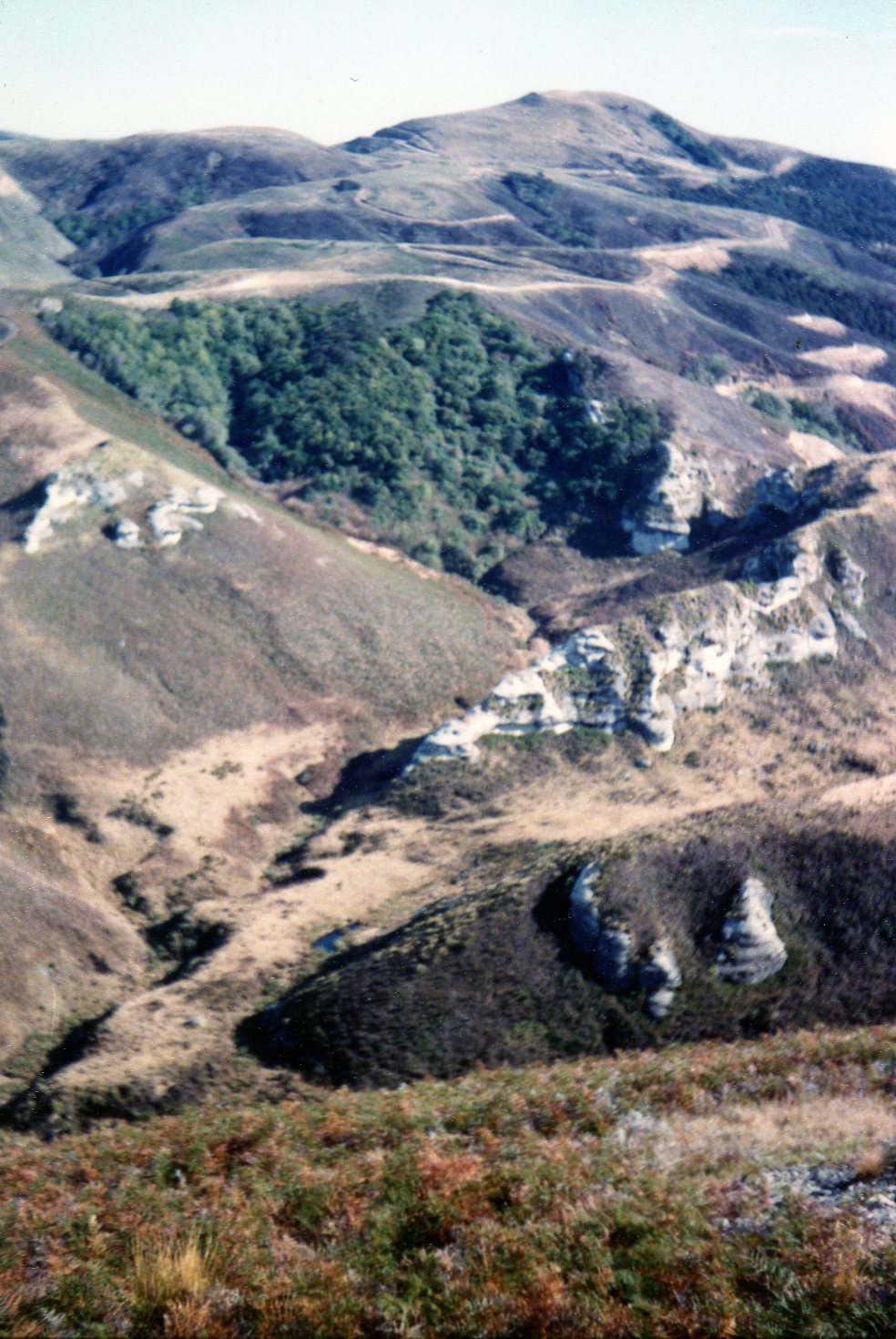
The beehive shape of the bluff has almost gone
because of the vegetation, but it is about 50metres high.


Already Mick and I had established the main access road, which I called 'Beehive Road' - no, not because of the bees, but because of the huge yellow sandstone bluff that was roughly the shape of a beehive. This bluff was the target of artillery reservists who practiced fired at the bluff from [apparently the coast]. We found many of the timed shrapnel shells around the bluff - lump of lead shot in them about the size of a large marble! Bloody hell who would like to be in a war with them flying/exploding overhead?

The lay of the land was a bit difficult, because we needed to put the road above the bluff and we did not really have much choice about the distance because the road took off past a small saddle - the old geometry thing, the hypotenuse is the grade - height is the vertical - distance the horizontal. The easier the better for all operations, especially log transport.
I took a reading with my Abney level from the saddle to the top of the bluff and wet forth through the scrub with 'survey cloth' - linen rag that is ripped into strips to 'flag', mark where the top of the 'cut' was to be. Meaning where the bulldozer made its first cut to form the road.
Actually I nearly fell over another small bluff that was hidden by scrub because it was right in the middle of the proposed road! This caused me to modify the line making on section of the road steeper than I would have liked, but it was a straight, short section, so not so bad.

Once the road was formed Colin and I carried out the survey and I plotted on a map, finishing the survey at the boundary strainer on Lindsay Clearwater's place.
Mick on the old D6 opened up the old tracks, making them useable for our vehicles and so we could plan the future roading pattern.

There was a leading ridge that headed West and fell steeply into the South Branch of the Waianakarua River, which was the boundary between the forest and Walter Rutherford's property. The whole area was clothed in quite magnificent Manuka/Kanuka forest and scrub with broadleaf forest in the gulleys. Actually this was the area I saw puffballs which are an indigenous truffles
.


Mick and I had seen deer sign along this ridge when we opened up the track along the top as we sat on the moss covered rocks to look down into the river bed. So we planned a days hunting - there were to be four of us, Mick, Merv McCabe (sen), Steve (Mag's young brother) and me.
On a cool, autumn morning we parked up at the end of the ridgetop track and Mick paired off with Steve to head down the Northern flank of the ridge, while Merv and I headed to the South. The Kanuka was tall and open because the understory had been grazed for years by sheep, deer and pigs, so the going was easy, it a little steep. Merv did not want to go down too far, because he thought of the climb out, so he headed along the contour Northwards while I kept on going down towards the river.
I hadn't gone very far, when in a small basin, I spotted two spikers [young stags] in a little basin. I decided to shoot both because I thought Merv was handy and would come down to help me with the carcases. He didn't arrive, but while I waited for him I took the back and fillet steaks and skinned the carcases and cut the backbone so we could each carry a set of hind quarters each.
It was my expectation that they would have heard my two shots, and would surely come to meet me, so I started the heft and climb out. I was used to the old imperial measurement and could visualize a cricket pitch at 22 yards [steps] and that equated to one chain and there were eighty chain in a mile. I counted 22 steps as I carried the first set of hind quarters up the steep hill. There I left them and went back down to collect the other set, and counted 11 steps after I passed the first set. From then on I took each set one chain at a time as I proceeded up the hill.

Meantime, the others had gathered back at the truck wand were waiting form me, and I was taking a long time. They had not heard my shots. Mick and Merv played tricks on young Steve, telling them that I go 'bush happy' when I am on my own and I might walk for miles - they might even come back tomorrow to find me. I worried the lad.

It took me until late afternoon to reach the ridge and for the others to hear my approach, and they came rushing to give me a hand - at last! They were pleased with my efforts and apologetic that I was left to lug the meat up on my own! Still we shared the meat as is usual, because another time it would they who did the shooting/carrying.
Actually, fit as I was, it had been a huge effort to carry those hind quarters out and secretly, it took me a couple of weeks to recover!

A more distant view of the South Block and the Beehive